Fire Damage Restoration Near Me: How to Choose Local Help After a House Fire
 Jul 28, 2026
 What should you know first?
Learn what local fire damage restoration should include, what a first smoke-and-soot assessment should cover, and how Michigan homeowners should compare providers after a fire.
Fire damage restoration near you should mean more than a company that can board up a door and hand you an estimate. After a house fire, you need a local team that can secure the structure, assess smoke and soot beyond the room of origin, account for water from firefighting, document the loss for the insurance claim, and carry the project through cleanup and rebuilding without losing track of the scope.
For Michigan homeowners, the best choice is usually a fire restoration company that can explain its process clearly, respond locally, and show how fire cleanup, smoke remediation, odor control, and reconstruction fit together. Miracle Property Restoration provides fire damage restoration across Fraser, Macomb County, and Southeast Michigan, including emergency stabilization, smoke and soot cleanup, and reconstruction support.
What should fire damage restoration near you actually include?
A fire loss is rarely limited to what looks black or burned. Even a contained kitchen or utility-room fire can leave the property with multiple issues at once:
- Openings that need emergency board-up or temporary protection
- Smoke and soot spread into nearby rooms, wall cavities, and HVAC pathways
- Water from firefighting that can soak finishes and structural materials
- Contents that need documentation, cleaning decisions, or pack-out planning
- A reconstruction scope that may change once cleanup reveals concealed damage
That is why a legitimate fire restoration project usually includes emergency stabilization, condition assessment, smoke and soot cleaning, odor treatment, selective demolition, drying where firefighting water is involved, and a clear plan for repair work afterward. If you want a broader explanation of the rebuild phase, see our guide to construction restoration after property damage.
What should the first fire-damage assessment include?
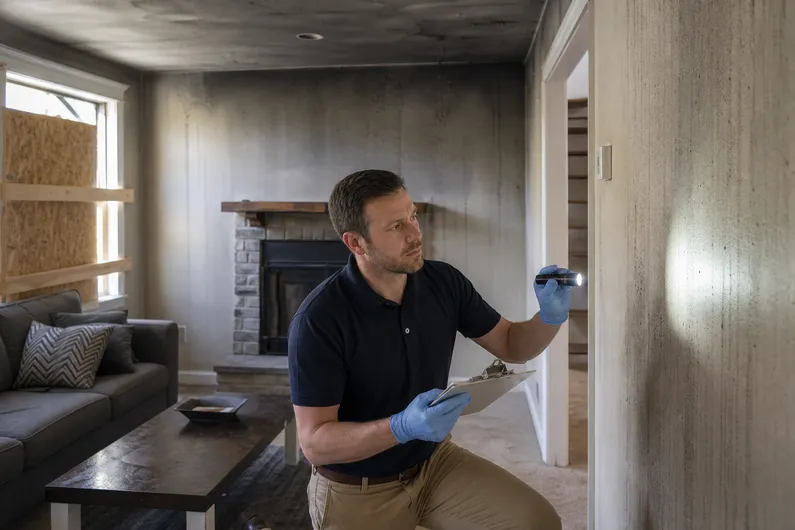
The first site visit should focus on scope and safety, not on a rushed promise that everything can be cleaned or saved. A qualified fire assessment should usually include:
- A safety and access review. The team should confirm what areas are safe to enter, what parts of the structure need to stay restricted, and what temporary protections are needed right away.
- Smoke and soot assessment beyond the obvious burn area. Fire residue often spreads farther than homeowners expect, especially through shared airspace, open floor plans, duct systems, and penetrations around outlets, fixtures, or framing transitions.
- Evaluation of firefighting water impact. A fire loss can also be a water loss. Wet drywall, insulation, flooring, framing, and contents need to be identified before cleanup and repairs get out of sequence.
- Contents and HVAC considerations. Upholstery, clothing, ductwork, and equipment may need separate decisions about cleaning, isolation, or replacement depending on the residue type and exposure.
- Documentation for the claim and next-step planning. Early photos, notes, and scope logic help explain why certain materials can be cleaned, why others need removal, and how the work should progress.
The ANSI/IICRC S700 Standard for Professional Fire and Smoke Damage Restoration is the main professional benchmark for assessing fire residues, odors, affected building systems, and contents after a fire. Homeowners do not need to know the standard line by line, but they should expect a professional company to follow a defined restoration process instead of improvising on site.
How should you compare local fire restoration companies?
After a fire, people often call the first company that answers. Speed matters, but the better question is whether the company can justify its plan once it arrives.
1. Can they handle both smoke remediation and rebuild planning?
Some companies are strong at emergency cleanup but weak at what comes next. Others are general contractors first and do not really specialize in smoke, soot, and odor work. Fire restoration needs both.
Ask whether the company can explain:
- How smoke and soot cleaning decisions are made
- How odor treatment is handled after residue removal
- How water from firefighting changes the mitigation scope
- How cleanup findings become a reconstruction scope
That transition matters. If the emergency phase and the rebuild phase are disconnected, the homeowner usually ends up absorbing the confusion.
2. Do they respond locally enough for the first day to matter?
“Near me” matters after a fire because the property may still need openings secured, residue documented before disturbance, and smoke spread assessed quickly. A company should be able to explain where it actually works, who responds after hours, and how it handles emergency board-up, tarping, or temporary controls in your area.
That local presence matters in Southeast Michigan, where response logistics, municipal expectations, and housing stock vary across Fraser, Warren, Clinton Township, Sterling Heights, and neighboring communities. A local team is usually better positioned to move from emergency stabilization into a realistic recovery plan without a long handoff delay.
3. Are they properly credentialed, licensed, and insured for fire work?
Ask direct questions:
- Are your technicians trained for fire, smoke, and soot restoration work?
- Is the company insured for the work it performs?
- If reconstruction is required, who is licensed and responsible for those trades?
- Who manages permits and code-related repairs if the fire affected structural or mechanical systems?
Clear answers matter. Fire losses often involve more coordination than homeowners expect, and vague responsibility at the front end creates expensive delays later.
4. Do they document the loss in a way that supports the insurance claim?
Insurance decisions still belong to the carrier, but the restoration company plays a major role in making the loss understandable. A qualified team should document visible fire damage, smoke spread, soot conditions, affected contents, firefighting water, demolition findings, and any hidden damage discovered as work progresses.
That usually means:
- Early photographs of all affected areas
- Notes about soot, smoke, odor, and water conditions
- Records explaining what can be cleaned versus removed
- Documentation that supports supplements when concealed damage is found
- Clear communication about where mitigation stops and rebuilding begins
If you are still in the emergency stage, our guide on what to do in the first 24 hours after a house fire in Michigan explains the first-day decisions that protect both safety and documentation.
5. Will they explain what is still unknown?
This is one of the easiest ways to tell whether you are dealing with a professional or a salesperson. A legitimate restoration company should tell you what cannot be confirmed yet.
In a fire loss, that may include:
- Whether odor has spread into concealed assemblies
- Whether HVAC cleaning will be required
- Whether demolition will reveal more heat or smoke damage
- Whether wet materials from suppression can still be dried or must be removed
- Whether contents cleaning is practical for specific items
Be cautious if a company gives a complete, all-inclusive answer before it has inspected the residue, the water impact, and the hidden spaces that may affect the final scope.
Why fire losses need a more technical response than many homeowners expect
Fire damage is not only about charred framing or visible soot. It also involves how smoke residues spread, what burned, how odors bonded to surfaces, and whether water from suppression introduced a second layer of damage. The NFPA home structure fire research is a reminder that house fires remain a major property-loss event in the United States, and the cleanup decisions made early can shape the total recovery path.
That is why homeowners should be wary of anyone who treats a fire loss like a simple cleaning job. For a deeper explanation of how residues behave, see our article on soot vs. smoke damage after a fire.
Red flags when choosing a fire restoration company
Watch for:
- Pressure to sign broad work authorization before the scope is explained
- Promises that every damaged material can be saved
- No discussion of smoke spread outside the burn room
- No plan for firefighting water, drying, or odor control
- Vague answers about credentials, insurance, or reconstruction responsibility
- A sales pitch centered on speed without a defensible process
Fast response matters, but fire cleanup without a clear sequence often makes the project harder to finish well.
When should you call a fire restoration company immediately?
Call right away when the structure needs board-up, residue is present, odor is spreading, firefighting water affected materials, or the property needs to be documented before cleanup changes the evidence. Fire losses do not improve while they sit.
If you are in Fraser, Macomb County, or nearby Southeast Michigan communities and need a local fire restoration team to assess the damage, explain the likely sequence, and coordinate cleanup with rebuilding, Miracle Property Restoration can help. Call (855) 324-2921 or contact our team to discuss the next step.
Frequently Asked Questions
What does this fire damage restoration near me: how to choose local help after a house fire guide explain?
Learn what local fire damage restoration should include, what a first smoke-and-soot assessment should cover, and how Michigan homeowners should compare providers after a fire.
When should a property owner contact a restoration professional?
Contact a qualified restoration professional when damage is active, hidden moisture may remain, regulated materials could be present, or the loss affects structural materials, indoor air quality, electrical systems, or normal building operations. Prompt assessment helps define safe next steps and limits avoidable secondary damage.
How does Miracle Property Restoration support a damage recovery project?
Miracle Property Restoration provides emergency stabilization, documentation, mitigation, remediation, and reconstruction for commercial and residential properties across Southeast Michigan. The team develops a property-specific scope, records conditions and progress, coordinates with project stakeholders, and restores affected areas after the immediate hazard is controlled.


