
Frozen Pipe Burst in a Restaurant — What to Do in the First 24 Hours
 Jun 5, 2026
 What should you know first?
A frozen pipe burst can shut down your restaurant for days. Here's exactly what Macomb County food service operators need to do — and not do — in the first 24 hours.
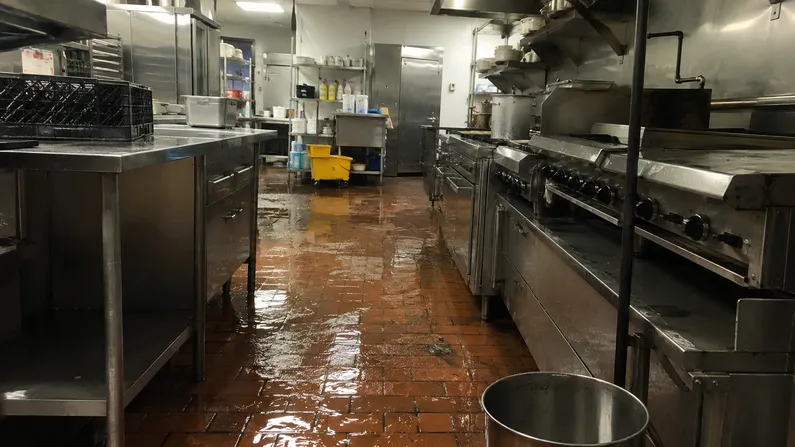
You show up Monday morning, and the water is already an inch deep near the hostess stand. Your prep cook called it in — the overnight temperatures dropped to single digits, a supply line behind the reach-in cooler gave out sometime after close, and now the dining room, the prep area, and the hallway leading to dry storage are all soaked. The walk-in cooler compressor is sitting in standing water. Your POS terminal is dark. The grout lines between your quarry tile are already pulling the water deep.
This is what a frozen pipe burst looks like in a restaurant, and the first hour of your response will determine whether you’re back open in four days or four weeks.
Why Restaurants Are Especially Vulnerable to Frozen Pipe Bursts
Commercial kitchens are built around water supply lines running to prep sinks, dishwashers, steam equipment, ice machines, and hand-washing stations. In Michigan, pipes routed along exterior walls or through uninsulated service corridors are especially exposed during sustained cold snaps. The problem isn’t just the volume of water that escapes when one of those lines fails. It’s where the water goes.
Restaurant flooring is almost never impermeable at the system level. Quarry tile and ceramic tile feel solid, but the grout joints absorb water immediately, and the mortar bed beneath them can hold moisture for weeks. Water that reaches your kitchen floor doesn’t just sit on the surface — it migrates under the tile, under the stainless steel equipment legs, and into the concrete substrate below. By the time you’re mopping, the damage is already in the floor.
Drywall behind prep stations, stainless steel wall panels, and the framing inside your service walls face the same problem. Water travels through wall cavities silently. The seams around your walk-in cooler panel system can let water in, but won’t let it out. What looks like a contained spill is often a building-wide moisture event that won’t reveal itself for days — by which point mold colonization has already begun.
The First Call You Need to Make — and It’s Not Your Plumber
Call your commercial water damage restoration company before you call your plumber. This isn’t a slight against plumbers — stopping the source is critical, and you’ll need one — but the sequence matters. A restoration company will begin moisture mapping, establish drying priorities, and document conditions for your insurance claim while the plumber is still in transit. Every hour of delay between pipe failure and active drying is time you’re losing on your claim timeline and your reopening date.
Your plumber will fix the pipe. Your restoration contractor will determine the scope of what’s actually wet. Those are two different problems, and conflating them costs operators time and money.
Call your insurance carrier or broker as your second call. Get a claim number. Note the time you arrived, the conditions you observed, and which areas were visibly affected. Photograph everything before you move anything.
Shut Down or Stay Open? How to Assess the Damage Quickly
The honest answer for most restaurant pipe bursts: you’re not opening today.
The factors that matter are the scope of water intrusion, which systems are affected, and whether the Michigan Department of Agriculture and Rural Development would consider your facility safe for food service operations. MDARD food service licensing requires that a licensed facility maintain sanitary conditions — a flooded kitchen with moisture in the walls, compromised equipment, and standing water does not meet that standard. Operating anyway isn’t a gray area; it’s a license risk.
If the water affected only a non-service area and your kitchen, dining room, and prep surfaces are confirmed dry by a moisture meter (not by visual inspection), you may have options. But if water reached your kitchen at all, presume you’re closed until you have written clearance from your restoration team and have notified your inspector.
What Happens to Your Kitchen Equipment, Inventory, and Flooring
This is where restaurant water damage diverges sharply from a standard commercial water loss. Your equipment is a separate claim conversation from your structure.
Commercial kitchen equipment — ranges, fryers, reach-in refrigerators, undercounter units, dishwashers — has electrical components that water exposure can compromise in ways that aren’t immediately visible. A unit that powers on the day after a flood may fail catastrophically two weeks later. Document every piece of equipment that was in the affected area, photograph it before it’s moved or cleaned, and do not assume it’s functional because it turns on.
Food inventory is a total loss the moment your refrigeration is compromised or contaminated water is present. Document everything with photographs and a written inventory before disposal. Your insurance adjuster will need this. Disposing of it without documentation is one of the most common mistakes restaurant owners make in the first few hours — and it limits what you can recover.
Flooring is where the long-tail costs live. If your restoration team isn’t pulling moisture readings from the mortar bed beneath your tile, the building is being dried to surface standards, not substrate standards. Quarry tile and ceramic floors in commercial kitchens routinely require full removal to dry the concrete and mortar below. Operators who are told their floors are “fine” by a crew using only surface fans frequently find themselves back in the same conversation six weeks later when mold appears or the tile starts popping.
Health Department Notification — When It’s Required in Michigan
Michigan food service operators are required to notify MDARD when a facility experiences a condition that may affect food safety or sanitary operation. A burst pipe with water intrusion into a kitchen or food storage area almost certainly meets that threshold.
Notification is not an admission of anything — it’s a legal requirement and, practically speaking, it’s better to get ahead of this than to have an inspector arrive during cleanup. Your MDARD district office can advise on whether a re-inspection is required before you reopen. Budget time for this in your reopening timeline. Inspectors in Macomb County handle a large volume of commercial facilities, and scheduling an emergency inspection takes time even when you’re cooperative and proactive.
How Professional Water Extraction Differs from Mopping It Yourself
A mop, a wet-vac, and a few box fans are not a restoration plan. They are delay and a liability.
Professional water extraction in a commercial kitchen involves truck-mounted extraction units capable of removing hundreds of gallons from flooring assemblies and concrete substrates, industrial air movers sized to the cubic footage of the space, and refrigerant or desiccant dehumidifiers operating continuously. Moisture readings are taken at the slab, at wall cavities, behind equipment, and inside ceiling assemblies at the start of every drying day.
The IICRC S500 standard for water damage restoration defines a specific drying goal — not “it feels dry,” but measurable moisture content targets in structural materials that match pre-loss conditions. Work that doesn’t reach those targets doesn’t qualify as complete remediation. Your insurance adjuster knows this. Your restoration contractor should be working on it.
Attempting to self-dry a flooded commercial kitchen also creates a documentation problem. Adjusters who see evidence of self-remediation before a professional assessment are within their rights to question the scope of the loss and the validity of subsequent claims.
What Your Commercial Property Insurance Will (and Won’t) Cover
Most commercial property policies cover sudden and accidental water damage from a burst pipe. Frozen pipe failures in Michigan winters generally qualify.
What they typically don’t cover: damage that occurred gradually over time (a slow drip that became a problem over weeks), water that entered from an external flood source rather than an internal pipe failure, and equipment breakdown as a distinct coverage trigger. Know your policy before you assume something is covered.
Your adjuster will want to see: photographs taken before any cleanup, a moisture mapping report from a certified restorer, an equipment inventory, a food loss inventory, and your business interruption documentation. If you’ve been operating without documenting your daily revenue, now is a painful time to reconstruct it — but your POS system records will help.
Business interruption coverage — if you carry it — typically kicks in after a defined waiting period and covers lost revenue up to your policy limits during the restoration period. Understand your waiting period. It matters enormously for how quickly you push your restoration contractor to move.
How Long Until a Restaurant Can Reopen After Water Damage?
For a moderate pipe burst affecting a kitchen and part of a dining room, realistic timelines run four to ten business days for drying and remediation, assuming work begins within 24 hours of the loss. Add time for equipment inspection and repair, any required flooring replacement, health department re-inspection, and your own operational readiness.
Operators who delay the first call by more than 12 to 24 hours routinely see those timelines double. Secondary damage — mold, warped flooring, delaminating wall materials — adds scope and cost that weren’t part of the original loss.
Miracle has worked through exactly this sequence before. In one full-service restaurant frozen pipe burst we handled, the initial damage looked contained to the front-of-house — until moisture mapping revealed saturation had traveled under the tile into the kitchen. Getting ahead of that finding on day one saved the operator nearly two weeks on their reopening timeline.
Working with a Restoration Company That Understands Food Service
Not every commercial restoration contractor understands the regulatory dimension of a restaurant loss. Health code implications, MDARD notification, equipment documentation, the distinction between surface-dry and substrate-dry — these aren’t generic commercial water damage concepts. They’re food-service-specific and affect reopening timelines, insurance outcomes, and license risk.
Miracle Property Restoration works with hospitality and food service facilities across Macomb and Oakland County and understands what’s at stake when a restaurant goes down. Our emergency response planning for commercial clients means we can move fast the moment the call comes in — and our commercial reconstruction services mean we can take the project from extraction through rebuild without you managing multiple contractors.
If you’re dealing with a restaurant pipe burst right now, call us at (855) 324-2921 or visit miracle.construction. Every hour you wait is a longer reopening timeline.
Frequently Asked Questions
What does this frozen pipe burst in a restaurant — what to do in the first 24 hours guide explain?
A frozen pipe burst can shut down your restaurant for days. Here's exactly what Macomb County food service operators need to do — and not do — in the first 24 hours.
When should a property owner contact a restoration professional?
Contact a qualified restoration professional when damage is active, hidden moisture may remain, regulated materials could be present, or the loss affects structural materials, indoor air quality, electrical systems, or normal building operations. Prompt assessment helps define safe next steps and limits avoidable secondary damage.
How does Miracle Property Restoration support a damage recovery project?
Miracle Property Restoration provides emergency stabilization, documentation, mitigation, remediation, and reconstruction for commercial and residential properties across Southeast Michigan. The team develops a property-specific scope, records conditions and progress, coordinates with project stakeholders, and restores affected areas after the immediate hazard is controlled.


