Home Restoration Company Near Me: How to Choose the Right Team After Property Damage
 Jul 20, 2026
 What should you know first?
Learn how Michigan homeowners should compare local restoration companies after water, fire, or mold damage, and what a qualified first site visit should include.
A home restoration company near you should be able to do more than answer the phone and offer a cleanup estimate. After water, fire, mold, or other property damage, you need a team that can assess the loss correctly, stabilize the home, document conditions for the insurance claim, and carry the work through mitigation and rebuilding without creating new problems.
For Michigan homeowners, the best choice is usually a local restoration company with relevant loss experience, IICRC-certified technicians, proper licensing and insurance, and a clear process for documentation and communication. Miracle Property Restoration provides water damage restoration, fire and smoke damage restoration, mold remediation, and reconstruction support across Fraser, Macomb County, and Southeast Michigan.
What a home restoration company actually does
Many homeowners search for a “home restoration company near me” when they are really trying to solve several problems at once:
- Stop ongoing damage
- Find out what materials are actually affected
- Protect the insurance claim
- Get the home back to normal as efficiently as possible
A qualified restoration company works across those stages. In a water loss, that may mean emergency extraction, moisture mapping, drying, selective demolition, and reconstruction planning. After a fire, it may involve emergency board-up, smoke and soot assessment, odor control planning, cleaning, and repairs. In a mold situation, it may require moisture-source investigation, containment, removal of unsalvageable materials, and controlled rebuilding.
That is different from hiring a general contractor first, or hiring separate companies that only handle one piece of the problem. If you want a broader explanation of the rebuild phase specifically, see our guide to construction restoration after property damage.
What the first site visit should include
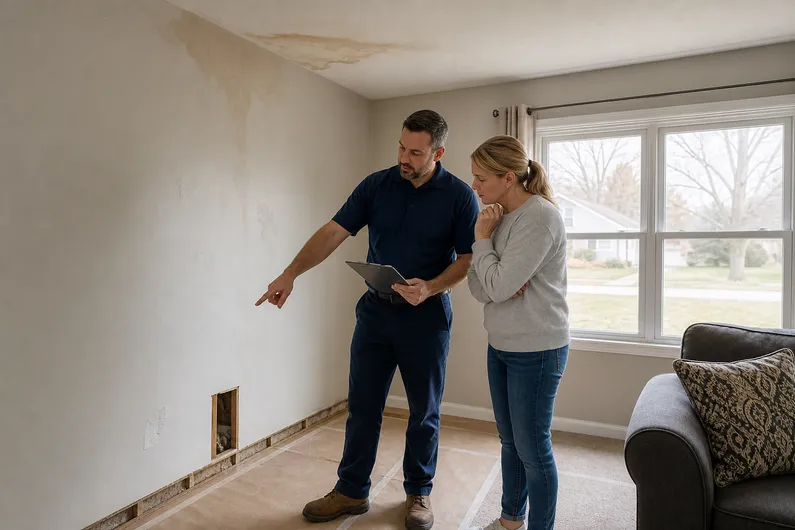
The first walkthrough is where a good restoration company separates itself from a company that is just selling urgency. A qualified site visit should focus on conditions, safety, and scope, not on promises before the property is understood.
In most residential losses, the first visit should include:
- A visual review of the damaged area and adjacent spaces. The team should look beyond the obvious room because water, smoke, and hidden moisture rarely stay where the homeowner first notices them.
- Documentation of visible conditions. Photos, notes, and observations made early help support later insurance communication and help explain why certain materials can be dried, cleaned, removed, or rebuilt.
- A discussion of immediate safety concerns. Electrical hazards, structural instability, contamination, and indoor air concerns should be addressed before anyone talks about finishes and paint colors.
- A preliminary explanation of what happens next. That includes what can be assessed immediately, what may require further opening or testing, and which decisions depend on moisture readings, inspection findings, or adjuster approval.
- A realistic conversation about limits. No legitimate restoration company should guarantee during the first visit that every material can be saved or that the insurer will approve every line item.
For water losses in particular, the IICRC S500 standard is the benchmark for professional water-damage restoration. For smoke and fire losses, the IICRC S700 standard helps govern proper fire and smoke restoration work. Homeowners do not need to memorize those standards, but they should expect a professional company to work within them.
How to compare home restoration companies near you
When several companies serve your area, compare them using concrete criteria rather than ad language. These are the questions that matter most.
1. Do they handle your specific type of loss?
Property damage is not one category. A team that is competent with emergency water mitigation is not automatically the best choice for smoke damage, mold remediation, or regulated-material concerns.
Ask what kinds of residential losses the company handles routinely:
- Clean-water and contaminated-water damage
- Fire, soot, and smoke damage
- Mold growth after hidden moisture or long-standing leaks
- Selective demolition and reconstruction after mitigation
- Insurance-driven documentation and supplements
If the company cannot explain the difference between drying, cleaning, demolition, and reconstruction, you are probably talking to a contractor who is too narrow for a full restoration project.
2. Can they respond locally and explain their service area clearly?
“Near me” matters because emergency response time matters, but proximity alone is not enough. A restoration company should be able to explain where it works regularly, how quickly it can reach your property, and whether it has crews who actually serve your municipality.
That matters in Southeast Michigan because response logistics, housing stock, and permit coordination vary across Fraser, Warren, Clinton Township, Sterling Heights, and nearby communities. A local team is more likely to understand common building conditions, municipal expectations, and how to coordinate the handoff from mitigation into repairs.
3. Are they properly credentialed and insured?
Ask direct questions:
- Are your technicians IICRC-certified for the type of work you are proposing?
- Is the company insured for the work it performs?
- If reconstruction is needed, are the required trades properly licensed?
- Who is responsible for permits when the project moves into rebuilding?
Credentials do not guarantee good work, but vague answers here are a red flag. A homeowner should not have to guess who is accountable for drying, demolition, smoke cleaning, or reconstruction.
4. Do they document the loss well enough for an insurance claim?
Insurance decisions come from the carrier, not the restoration company. But a competent restoration company should still know how to document conditions, scope, and progress in a way that helps the claim make sense.
That usually means:
- Early photographs and written notes
- Moisture or condition readings where appropriate
- Records of affected materials and rooms
- Daily or periodic progress documentation
- Clear explanations when hidden damage is discovered later
For homeowners dealing with water losses, our guide to water damage insurance in Michigan explains where the restoration company’s role stops and where the insurer’s role begins.
5. Can they carry the project from mitigation into rebuilding?
One of the most common homeowner frustrations is being told the emergency phase is complete, only to discover that the next contractor has a different opinion about what is still wet, still contaminated, or still undocumented.
Ask whether the company can coordinate both mitigation and reconstruction, or whether there will be a handoff. Neither model is automatically wrong, but the transition needs to be clear:
- Who confirms the structure is ready for rebuild?
- Who updates the scope if hidden damage appears after demolition?
- Who communicates with the adjuster if the repair estimate changes?
- Who is responsible for schedule coordination once repairs begin?
A restoration company that can explain that process clearly is usually more prepared than one that only talks about emergency response.
6. Will they explain what they do not know yet?
This point is underrated. Good restoration professionals identify uncertainty early. They should tell you when the final scope depends on opening a wall, checking subfloor moisture, evaluating HVAC contamination, or waiting for adjuster approval.
Be cautious if a company gives a fast, confident, all-inclusive answer before it has inspected hidden assemblies or reviewed the actual loss conditions. Restoration work is technical because so much of the damage is not obvious on the first walk-through.
Red flags when hiring a home restoration company
Homeowners are often making decisions under stress, which is exactly when low-quality contractors become harder to spot. Watch for:
- Pressure to sign broad work authorizations before the scope is explained
- Claims that insurance will “cover everything”
- No explanation of how drying, cleaning, or demolition decisions are made
- No documented plan for communication or updates
- Generic promises that every material can be saved
- Vague answers about certifications, insurance, or reconstruction responsibility
- A sales pitch that focuses on speed but not on process
Fast response matters, but speed without a defensible plan can increase the total cost of the loss rather than reduce it.
Why local homeowners should care about process, not just price
The cheapest estimate is not always the cheapest project. If a company under-documents the loss, misses hidden moisture, or begins repairs before the home is ready, the homeowner can end up paying again when odors return, finishes fail, or mold appears later.
The better question is whether the proposed plan matches the condition of the property. In restoration, process protects outcome:
- Water losses need verified drying, not just visible dryness
- Smoke losses need cleaning and deodorization that address residue, not just surface appearance
- Mold problems need moisture correction and controlled removal, not cosmetic treatment
- Reconstruction needs to begin at the right time, with the right documentation behind it
That is why the best local restoration company is usually the one that explains the sequence well, documents it well, and does not pretend a complex loss is simple.
When to call a home restoration company immediately
Call right away when damage is active, expanding, or likely to affect structural materials, indoor air, or safety. That includes:
- Water that has reached drywall, flooring, insulation, or lower levels
- Smoke or soot residue after a fire, even when flames were limited to one area
- Musty odor or visible mold growth following a leak or humidity problem
- Ceiling stains, warped flooring, or wall damage that suggests hidden spread
- Situations where you need to document the condition before cleanup changes it
If you are in Fraser, Macomb County, or surrounding Southeast Michigan communities and need to understand your next step, Miracle Property Restoration can assess the loss, explain the likely sequence, and help you decide whether the property needs emergency mitigation, controlled remediation, reconstruction planning, or all three. Call (855) 324-2921 or contact our team.
Frequently Asked Questions
What does this home restoration company near me: how to choose the right team after property damage guide explain?
Learn how Michigan homeowners should compare local restoration companies after water, fire, or mold damage, and what a qualified first site visit should include.
When should a property owner contact a restoration professional?
Contact a qualified restoration professional when damage is active, hidden moisture may remain, regulated materials could be present, or the loss affects structural materials, indoor air quality, electrical systems, or normal building operations. Prompt assessment helps define safe next steps and limits avoidable secondary damage.
How does Miracle Property Restoration support a damage recovery project?
Miracle Property Restoration provides emergency stabilization, documentation, mitigation, remediation, and reconstruction for commercial and residential properties across Southeast Michigan. The team develops a property-specific scope, records conditions and progress, coordinates with project stakeholders, and restores affected areas after the immediate hazard is controlled.


