Mold Remediation in Michigan: What Property Owners Should Expect
 Aug 3, 2026
 What should you know first?
Learn how professional mold remediation works in Michigan, how to evaluate a contractor, and what homeowners and building managers should expect from containment through reconstruction.
Mold remediation in Michigan should do three things: stop the moisture that allowed growth, keep contamination from spreading during the work, and remove or clean affected materials using a documented plan. Spraying a surface and painting over it is not remediation, and a promise to make a building completely “mold free” is not a realistic standard.
For homeowners and property managers, the most important decision is not which company offers the fastest treatment. It is which company can explain the moisture source, the affected area, the containment strategy, the removal and cleaning methods, and the conditions that must be met before reconstruction begins. Miracle Property Restoration provides professional mold remediation for homes and commercial properties in Fraser, Macomb County, and Southeast Michigan.
What makes mold remediation in Michigan different?
The remediation principles are consistent nationwide, but Michigan buildings face a particular mix of seasonal and construction-related moisture conditions. Humid summers can create condensation on cool basement walls, pipes, and ductwork. Freeze-thaw cycles can expose foundation and exterior drainage problems. Roof leaks, ice dams, sump pump failures, appliance leaks, plumbing losses, and wet building materials can all support growth when moisture remains trapped.
The local lesson is simple: visible mold is often the symptom, not the whole problem. A patch at the bottom of a basement wall may trace back to foundation seepage, a plumbing connection, surface condensation, or an earlier water loss that never dried completely. Removing the stained drywall without identifying the moisture path can set up the same problem behind the replacement material.
Michigan also does not issue a state certification specifically for mold remediators or mold testing companies. The Michigan Department of Health and Human Services mold guidance states this directly. Property owners should therefore evaluate actual training, relevant certifications, insurance, project experience, references, and the written scope instead of relying on a vague claim that a contractor is “state certified” for mold.
When is professional mold remediation appropriate?
Not every discolored spot requires a full containment project. A small area of surface growth caused by a corrected, isolated moisture event may be manageable with appropriate precautions. Professional assessment becomes more important when:
- Growth covers a large or expanding area
- Mold returns after prior cleaning or painting
- Drywall, insulation, carpet, ceiling tile, or other porous materials are affected
- The source may be inside a wall, ceiling, floor system, or HVAC pathway
- The condition followed flooding, sewage, or a long-running water loss
- Occupants include people with asthma, chronic lung disease, allergies, or weakened immune systems
- The property is a school, healthcare facility, multifamily building, workplace, or occupied commercial space
- The work may affect structural materials or require coordinated reconstruction
The CDC’s mold cleanup guidance notes that people with asthma, chronic respiratory disease, immune suppression, or underlying lung disease should not participate in mold cleanup. A restoration contractor can assess building conditions, but medical symptoms and individual exposure concerns belong with a qualified healthcare professional.
What should happen before removal begins?
A credible remediation project begins with investigation and scope development. The contractor should not start opening walls simply because a musty odor or dark spot is present.
1. Document the visible condition
The initial record should identify where growth, staining, deterioration, and moisture are visible. Photographs, room notes, material types, and the relationship between affected and unaffected areas help establish the starting condition. This documentation is especially useful when an insurance claim, tenant issue, or independent environmental consultant is involved.
2. Trace the moisture source
The team should look for active leaks, past water migration, elevated humidity, condensation, drainage problems, or building-envelope failures. Moisture readings and thermal patterns may help locate suspect areas, but instruments support the investigation rather than replace physical reasoning.
If a wet basement or sump event started the problem, our guide to why basements flood in Fraser and Macomb County explains several common local pathways.
3. Define the affected materials and boundaries
Drywall, insulation, carpet pad, ceiling tile, and other porous materials often require different decisions than concrete, metal, glass, or other hard surfaces. The written scope should describe what is expected to be removed, what may be cleaned and retained, and what hidden conditions could change that plan once controlled demolition begins.
4. Decide whether testing adds value
Visible growth does not always need laboratory identification before remediation. The work still has to address moisture and remove contamination regardless of the species name. Testing can be useful when growth is suspected but not visible, when a consultant is defining the scope, when documentation is required for a dispute or transaction, or when post-remediation verification is part of the project plan.
The person who performs testing should be able to explain what question the sample will answer and how the result could change the scope. Testing without a decision behind it adds cost but not necessarily clarity.
How does professional mold remediation work?
The exact sequence depends on the building and the size of the affected area, but a defensible project usually follows these stages.
Containment and access control
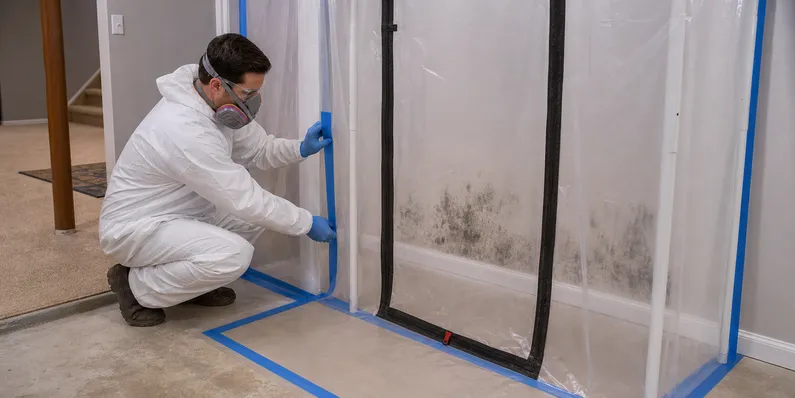
Before disturbing affected material, the work area is separated from occupied or clean areas. Polyethylene barriers, sealed openings, controlled entry points, and pressure or filtration controls may be used according to the scope. HVAC registers serving the work zone may also need protection or isolation so dust is not carried through the building.
The purpose of containment is not theater. Cutting or removing mold-affected drywall can release dust and spores. The barrier creates a controlled work zone for removal, cleaning, and waste handling.
Personal protective equipment
Workers use respiratory, eye, skin, and hand protection appropriate to the work. The CDC recommends at least a NIOSH-approved N95 respirator for mold cleanup and more protective respiratory equipment for prolonged removal work such as tearing out moldy drywall. A professional scope should also address how workers enter, exit, and remove contaminated disposable items without carrying debris into clean areas.
Controlled removal and cleaning
Porous materials that cannot be adequately cleaned are removed within containment and placed into sealed waste bags or containers before leaving the work zone. Remaining structural or nonporous surfaces are cleaned using methods suited to the material and condition. This may include HEPA vacuuming and damp wiping after the contaminated materials are removed.
The EPA mold remediation guide explains that moldy porous materials may need to be discarded because growth can penetrate their spaces and become difficult or impossible to remove completely. It also recommends HEPA vacuuming for final cleanup after materials have dried and contaminated materials have been removed.
Moisture correction and drying confirmation
Remediation is incomplete if the water problem remains. Plumbing, roof, foundation, drainage, humidity, or condensation issues need correction by the appropriate party. Materials that will remain in the assembly should be dry enough for reconstruction, and the contractor should be able to explain how that condition was evaluated.
Final cleaning, verification, and documentation
After removal, the contained area receives a detailed final cleaning. The project criteria may include a visual inspection, confirmation that dust and debris are absent, moisture checks, and independent post-remediation verification when it was specified in advance. The closeout record should identify what was removed, what was cleaned, what moisture correction occurred, and what remains for reconstruction.
Reconstruction after remediation
New drywall, insulation, flooring, trim, or finishes should not conceal unresolved moisture or an incomplete work area. Reconstruction begins after the remediation criteria are satisfied and the source has been corrected. Because restoration and rebuilding are connected, it helps to work with a team that can carry findings from the controlled removal phase into a clear repair scope.
How long does mold remediation take in Michigan?
A small, accessible project may take a few working days. A larger residential or commercial project can take longer when it involves multiple rooms, hidden cavities, contents, independent testing, source repairs, occupied-space coordination, or reconstruction.
Weather can affect the surrounding moisture conditions, but the timeline should be based on the project scope rather than a generic promise. A useful schedule separates:
- Assessment and scope development
- Moisture-source correction
- Containment and remediation work
- Final cleaning and any verification
- Reconstruction and finish work
Ask what could extend each stage. Contractors who acknowledge unknowns before opening an assembly are often giving a more reliable answer than those who promise a fixed completion date from a phone description.
Does homeowners insurance cover mold remediation in Michigan?
Coverage usually depends on why the mold developed and what the policy says. Mold related to a sudden covered water event may be treated differently from growth caused by chronic seepage, long-term humidity, deferred maintenance, or flooding. Some policies also contain mold limits or exclusions.
The restoration company does not decide coverage. Its role is to document the observed conditions, the likely moisture source, the affected materials, and the work performed. Report the loss promptly, preserve photographs and records, and ask the insurer to explain applicable limits in writing. Our Michigan water-damage insurance guide covers documentation questions that often overlap with mold-related water losses.
How should you compare Michigan mold remediation contractors?
Because Michigan does not certify mold remediators at the state level, property owners need to examine the substance behind each proposal. Ask every contractor the same questions:
- What training and industry certifications do the technicians hold?
- How will you identify and document the moisture source?
- What containment and access controls does this project require?
- Which materials are expected to be removed, and which may be cleaned?
- How will debris leave the work area without crossing clean spaces?
- What completion criteria will you use before containment comes down?
- When do you recommend an independent environmental professional?
- What records will I receive at the end of the project?
- Who is responsible for source repairs and reconstruction?
- Can you provide proof of current insurance and relevant project references?
The ANSI/IICRC S520 Standard for Professional Mold Remediation is a recognized industry framework for professional mold remediation. A contractor should be able to describe how its process follows accepted remediation principles without using certification language as a substitute for a property-specific scope.
Red flags in a mold remediation proposal
Be cautious when a proposal relies on any of the following:
- A claim that the company is “Michigan-certified” for mold without explaining the credential
- A treatment-only plan that never addresses moisture
- A promise to eliminate every mold spore from the building
- No containment plan before cutting or demolition
- A price based only on square footage without inspecting materials and access
- Mandatory testing that has no stated purpose or decision threshold
- Painting, coating, or fogging presented as a substitute for physical removal and cleaning
- Reconstruction scheduled before the source and completion criteria are resolved
A sound proposal should make the work understandable. You should know what condition the contractor found, what it plans to control, what it plans to remove or clean, and how everyone will know the remediation phase is complete.
What should Michigan property owners do next?
If you find visible growth or a persistent musty odor, avoid disturbing the area, stop active water when it is safe to do so, limit access, and document the condition. Do not aim a household fan at the growth or begin opening walls before deciding how the work area will be controlled. For a closer look at residential warning signs and common misconceptions, see our guide to black mold in Michigan basements.
Miracle Property Restoration serves Fraser, Warren, Sterling Heights, Clinton Township, Macomb County, and nearby Southeast Michigan communities. If you need help defining the moisture source, containment needs, remediation scope, and reconstruction path, call (855) 324-2921 or contact our restoration team.
Frequently Asked Questions
What does this mold remediation in michigan: what property owners should expect guide explain?
Learn how professional mold remediation works in Michigan, how to evaluate a contractor, and what homeowners and building managers should expect from containment through reconstruction.
When should a property owner contact a restoration professional?
Contact a qualified restoration professional when damage is active, hidden moisture may remain, regulated materials could be present, or the loss affects structural materials, indoor air quality, electrical systems, or normal building operations. Prompt assessment helps define safe next steps and limits avoidable secondary damage.
How does Miracle Property Restoration support a damage recovery project?
Miracle Property Restoration provides emergency stabilization, documentation, mitigation, remediation, and reconstruction for commercial and residential properties across Southeast Michigan. The team develops a property-specific scope, records conditions and progress, coordinates with project stakeholders, and restores affected areas after the immediate hazard is controlled.


