
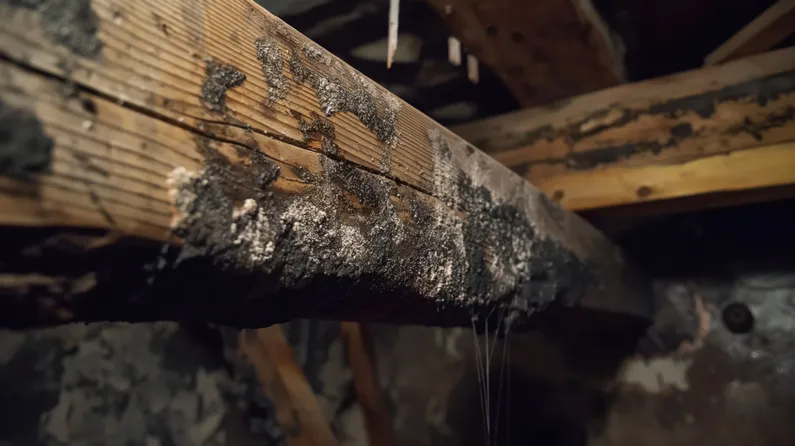
Black Mold Found in My Basement: Is It Dangerous and What Should I Do?
 Mar 24, 2026
 What should you know first?
Found black mold in your basement? Learn what it means for your health, whether it's toxic, and what Fraser and Macomb County homeowners should do next.
Discovering black mold in your basement is alarming - and understandably so. But before you start making decisions, it helps to understand what you’re actually dealing with. “Black mold” is one of the most misunderstood terms in home repair, and a lot of what circulates online about it is either exaggerated or flat-out wrong. Here’s what Fraser and Macomb County homeowners actually need to know: the health risks, the realistic remediation process, and what not to do while you figure out your next step.
What Is Black Mold, Actually?
The term “black mold” is a description of color, not a species. When most people say it, they mean Stachybotrys chartarum, a slow-growing mold associated with chronic water damage and high-cellulose materials like drywall and wood. It does tend to appear dark greenish-black. But many other common molds also appear black, including Cladosporium, Aspergillus niger, and Alternaria. You cannot identify a mold species by color alone - that requires laboratory testing.
Here’s the practical implication: all mold growth warrants concern and action, not just Stachybotrys. The myth that only “toxic black mold” (a term the CDC discourages because it implies other molds are safe) requires professional attention leads homeowners to ignore growth that can still cause respiratory symptoms and structural damage. If you’ve found black mold in your basement, assume it needs to be addressed regardless of whether a test would identify it as Stachybotrys or something else.
Is Black Mold in Your Basement Dangerous?
The honest answer is: it depends on several factors, including the extent of the growth, how long it has been present, how well-ventilated the space is, and the health status of the people in the home.
According to the CDC’s published guidance on mold and health, mold exposure can cause nasal stuffiness, throat irritation, coughing or wheezing, eye irritation, and skin irritation in otherwise healthy people. For individuals with mold allergies, asthma, or compromised immune systems, symptoms can be more severe and have a more rapid onset. Children and elderly individuals are also at higher risk. The EPA similarly notes that people with chronic respiratory conditions should not be in a space with active mold growth.
What’s important to understand is that risk is tied to exposure duration and volume. A small patch of black mold in your basement on a surface you rarely contact is a very different situation than widespread mold growth throughout a finished basement where your family spends regular time. Neither situation should be ignored, but they warrant different levels of urgency.
The mycotoxins produced by Stachybotrys - the primary health concern associated with the species - are only produced under specific conditions and require sustained, high-volume exposure to cause serious illness. This doesn’t mean black mold in your basement is safe to live with; it means the fear-based framing you’ll find in many online articles overstates the immediate danger in most residential situations. Your goal should be prompt professional remediation, not panic.
How Did Mold Get in Your Basement?
Mold requires three things: moisture, an organic food source, and warmth. Basements provide all three in abundance. The question is where the moisture is coming from - because eliminating the source is just as important as removing the mold itself. If the moisture problem isn’t fixed, the mold will return.
In Macomb County, the most common moisture sources in basements are flooding from sump pump failure or heavy rainfall, pipe leaks (supply lines, drain lines, or appliance connections), condensation from humidity - particularly common in uninsulated basement walls during Michigan’s humid summers - and foundation seepage through porous concrete or deteriorating waterproofing. Read our resource on why basements flood in Fraser and Macomb County for a detailed look at the regional factors that make this area particularly vulnerable.
Mold growth that shows up after a flood or sewage backup is straightforward to trace. Growth that appears without an obvious recent water event usually indicates a slow, hidden source - a pinhole pipe leak, chronic high humidity, or foundation seepage that hasn’t yet caused visible water intrusion. A professional inspection will identify the source and recommend mitigation before remediation begins.
What Not to Do When You Find Mold
Before anything else, here’s what you should not do - because each of these common reactions makes the problem worse.
Don’t disturb it. Mold reproduces by releasing spores, and disturbing a mold colony - by scrubbing, scraping, or even walking past it with airflow from a fan - releases those spores into the air. Once airborne, they travel through your HVAC system and can establish colonies in parts of the house that weren’t previously affected. This is why professional remediation always begins with physical containment before any removal work starts.
Don’t spray it with bleach. This is the most persistent myth in residential mold response. Bleach’s active ingredient, sodium hypochlorite, kills surface mold on non-porous materials like tile or glass. But on porous materials - drywall, wood, concrete - bleach doesn’t penetrate deeply enough to reach the root structures (hyphae) of the mold colony. The surface turns white and looks clean, but the biological structure underneath survives, regrows, and often comes back faster than before. Bleach also adds moisture to the surface, which mold needs to thrive.
Don’t run fans or your HVAC. Increased airflow spreads spores. Turn off forced air systems that circulate through the basement and leave the space as undisturbed as possible until a professional assessment is complete.
If you’ve found black mold in your basement in Fraser or Macomb County, call Miracle Property Restoration at (855) 324-2921 before you do anything else. We offer free assessments and can tell you exactly what you’re dealing with - 24/7.
What a Professional Mold Inspection Actually Looks For
A legitimate mold inspection is significantly more thorough than looking at what’s visible on the surface. A qualified inspector - or a restoration company with certified technicians - will use thermal imaging cameras to detect temperature differentials that indicate hidden moisture behind walls and under flooring. They’ll use moisture meters to measure the water content of building materials and identify areas with readings high enough to support continued mold growth even without visible water.
They’ll also assess the extent of visible mold growth, identify the likely source, evaluate HVAC systems for mold presence in ductwork, and, in some cases, perform air quality sampling to measure spore counts. This assessment determines the scope of remediation needed and whether containment is necessary before work begins. The IICRC S520 Standard for Professional Mold Remediation defines the protocols that guide legitimate remediation work - it’s the industry benchmark that separates a professional restoration company from a handyman with a spray bottle.
Do You Need Mold Testing Before Remediation?
This is a question we get often, and the answer is more nuanced than most people expect: sometimes, but usually not as a first step.
If you can see mold growth, you already know you have a mold problem. Testing to confirm what type of mold it is generally doesn’t change the remediation approach - the process for removing Stachybotrys and the process for removing Cladosporium are essentially the same. Pre-remediation testing adds cost and delay without meaningfully changing what happens next.
Where testing does make sense is in two specific situations. The first is post-remediation verification - air sampling after the remediation work is complete to confirm that spore counts have returned to normal outdoor levels. This is legitimate quality assurance and protects you from a company claiming the work is done when it isn’t. The second is when mold is suspected but not visible, and you need objective evidence to support an insurance claim or a real estate transaction. In those cases, air quality testing or surface sampling provides documentation that’s difficult to dispute.
How Mold Remediation Works in a Macomb County Home
Professional mold remediation in Macomb County follows a defined sequence. Cutting corners on any step creates conditions for recurrence, which is exactly what you’re trying to avoid.
Containment comes first. Plastic sheeting and negative air pressure are used to isolate the affected area and prevent spores from traveling to other parts of the home during the removal process. HEPA-filtered air scrubbers run continuously to capture airborne spores within the containment zone. This step is what separates professional remediation from DIY attempts - without it, remediation becomes a mechanism for spreading the problem.
Removal follows containment. Porous materials that are heavily contaminated - drywall, insulation, carpet, wood framing in severe cases - are bagged and removed per containment protocols. Non-porous surfaces are cleaned using EPA-registered antimicrobials. HEPA vacuuming removes residual spores from surfaces and materials being retained.
After removal, the affected area is treated and allowed to dry completely. In cases where flooding was the moisture source, this phase overlaps with water damage restoration - the structural drying that prevents recurrence has to be confirmed before any reconstruction begins.
Our IICRC-certified technicians serving Fraser, Warren, Sterling Heights, Clinton Township, and all of Macomb County follow S520 protocol on every job. Clearance testing after remediation is offered as part of our process when documentation is needed. For a full overview of our approach, visit our mold remediation in Fraser service page.
Frequently Asked Questions
Can I stay in my house if there’s mold in the basement?
In most cases, yes - but it depends on the extent of the growth and whether your HVAC system is circulating air through the affected space. A contained mold problem in an unfinished basement where you don’t spend time carries a lower risk than mold in a finished basement with a shared HVAC zone. If you have household members with asthma, respiratory conditions, allergies, or compromised immune systems, a professional assessment should happen as quickly as possible to determine whether temporary relocation is advisable. Children and elderly individuals should be considered higher-risk regardless of apparent symptom presentation.
How long does mold remediation take?
Most residential basement mold remediation jobs take between 1 and 5 days, depending on the affected area, the materials involved, and whether water damage remediation needs to happen concurrently. A small patch on a basement wall may be resolved in a single day. Widespread growth involving structural materials and multiple rooms will take longer. Your remediation company should give you a specific timeline after the initial assessment, not before it - be wary of any company that quotes a timeframe without first seeing the scope of the problem.
Will insurance cover mold removal?
Mold coverage through homeowner’s insurance is narrow and depends heavily on the cause. If the mold resulted from a covered water damage event - a burst pipe or appliance failure - your insurer may cover remediation as part of that claim. Mold resulting from ongoing maintenance issues, chronic leaks, or flooding from groundwater is generally not covered under standard policies. Documenting the moisture source and its cause is critical for establishing coverage. Miracle Property Restoration works directly with insurance companies and can help you navigate the claims process from the initial assessment through completion.
If you’ve found black mold in your basement anywhere in Fraser or Macomb County, call Miracle Property Restoration at (855) 324-2921. We’re available 24/7, we’re IICRC-certified, and we’ll give you a straight assessment of what you’re dealing with and what remediation will involve - no pressure, no guesswork.
Frequently Asked Questions
What does this black mold found in my basement: is it dangerous and what should i do? guide explain?
Found black mold in your basement? Learn what it means for your health, whether it's toxic, and what Fraser and Macomb County homeowners should do next.
When should a property owner contact a restoration professional?
Contact a qualified restoration professional when damage is active, hidden moisture may remain, regulated materials could be present, or the loss affects structural materials, indoor air quality, electrical systems, or normal building operations. Prompt assessment helps define safe next steps and limits avoidable secondary damage.
How does Miracle Property Restoration support a damage recovery project?
Miracle Property Restoration provides emergency stabilization, documentation, mitigation, remediation, and reconstruction for commercial and residential properties across Southeast Michigan. The team develops a property-specific scope, records conditions and progress, coordinates with project stakeholders, and restores affected areas after the immediate hazard is controlled.


