Commercial Restoration in Michigan: From Damage to Reopening
 Aug 10, 2026
 What should you know first?
Learn how commercial restoration stabilizes damage, coordinates water, fire, smoke, or mold work, and helps Michigan businesses plan a safe reopening.
Commercial restoration is the coordinated work required to make a damaged business property safe, stable, clean, dry, and usable again. It can include emergency protection, water mitigation, smoke and soot cleaning, mold remediation, selective demolition, contents handling, documentation, and reconstruction. The right sequence depends on what happened, how the building is used, and which areas can safely remain operational.
For a Michigan business owner or facility manager, the first goal is not to make the property look finished. It is to control the loss, protect people and business-critical assets, and build a documented path from emergency response to reopening. Miracle Property Restoration provides commercial reconstruction services and coordinates restoration work for offices, retail properties, warehouses, multifamily buildings, and other commercial facilities across Southeast Michigan.
What does commercial restoration include?
Commercial restoration begins after a fire, pipe break, roof leak, sprinkler discharge, mold condition, storm, vehicle impact, or other event disrupts a building. The project may involve several distinct types of work:
- Emergency board-up, temporary weather protection, access control, or utility coordination
- Water removal and structural drying after a plumbing, roof, sprinkler, or firefighting loss
- Smoke, soot, and odor assessment after a fire
- Containment and removal of mold-affected materials
- Inventory, protection, relocation, or cleaning of contents and equipment
- Selective demolition needed to reach damaged assemblies
- Repair or replacement of walls, ceilings, flooring, finishes, and building systems
- Final documentation and coordination for occupancy or phased reopening
Not every event requires every service. A burst supply line may call for commercial water damage restoration followed by limited finish repairs. A fire may involve structural damage, smoke residues, water from suppression, contents cleaning, and a larger rebuild. A long-running roof leak may reveal both deteriorated materials and a commercial mold condition that changes the work sequence.
The scope should follow the building conditions, not a standard package.
Why is commercial restoration different from residential work?
A commercial loss affects more than the damaged room. It can interrupt revenue, employee access, customer service, tenant operations, inventory movement, production schedules, data systems, and regulatory responsibilities. The same square footage can also be more complex because commercial buildings often contain larger mechanical systems, fire protection systems, specialized finishes, racking, machinery, multiple electrical panels, or separate tenant spaces.
Restoration planning therefore has to answer two questions at once:
- What work is necessary to restore the building?
- What can the business safely continue while that work is underway?
Those questions should be addressed together. A technically sound drying or cleaning plan can still create unnecessary disruption if access routes, work hours, noise, dust, deliveries, and employee communication are ignored. A fast reopening is not useful if it puts people into an area that has not been properly assessed or separates repairs from the original damage scope.
What should happen during the first day?
Life safety and emergency authority come first. Employees and visitors should follow fire department, police, utility, building official, and site emergency procedures. No contractor should encourage entry into an area that has not been released by the appropriate authority.
Once access is permitted, the restoration response should focus on a short list of priorities.
Stabilize the property
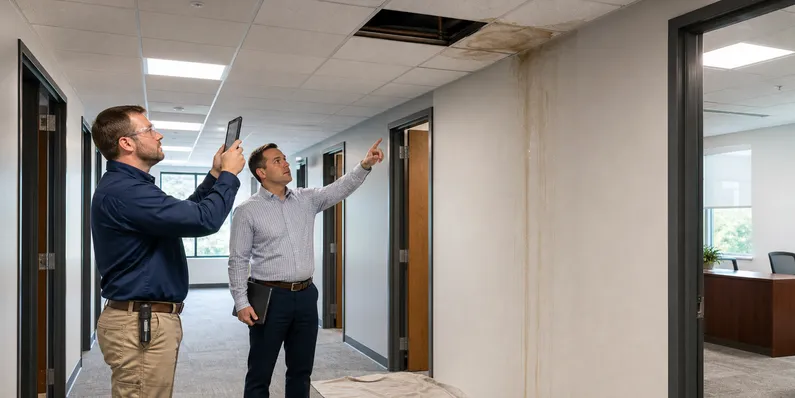
The team identifies active water, exposed openings, unsafe finishes, damaged doors, vulnerable inventory, and areas that need restricted access. Temporary protection may include board-up, roof covering, barriers, or coordination with qualified trades to isolate a damaged system. These measures limit further loss while the full scope is still being developed.
Record conditions before they change
Photographs, video, moisture information when relevant, room-by-room notes, equipment or inventory records, and a log of emergency work help establish the starting condition. Documentation should continue as materials are opened and hidden damage becomes visible. A commercial claim is easier to understand when the record connects each activity to a documented condition.
Identify business-critical areas
The contractor needs to know which rooms, utilities, loading areas, tenant spaces, records, equipment, and access routes matter most to operations. That does not mean an essential area can reopen before it is safe. It means the restoration sequence can be designed around real business priorities instead of treating every square foot as equally urgent.
Establish one communication path
The property owner should identify who can approve work, who communicates with employees or tenants, and who coordinates with the insurer, property manager, landlord, or other stakeholders. Ready.gov’s business emergency planning guidance emphasizes continuity, communications, emergency response, and IT recovery as connected parts of business preparedness. Those same connections matter after a loss.
How does the commercial restoration process work?
The details change by event, but a defensible project generally moves through the following stages.
1. Initial assessment and emergency scope
The restoration team documents visible damage, identifies immediate hazards within its area of responsibility, and defines the work needed to prevent avoidable secondary damage. Specialists may be required for structural engineering, electrical systems, roofing, hazardous materials, environmental testing, or fire protection systems.
The first scope is often provisional. Water can travel behind finishes, smoke can migrate beyond the room of origin, and demolition can expose conditions that were not visible during the initial walkthrough. A credible contractor explains what is known, what remains uncertain, and what evidence would change the plan.
2. Mitigation and remediation
Mitigation controls the active effects of the loss. For water damage, this may include extraction, removal of unsalvageable wet materials, controlled drying, and monitoring. For fire damage, the work may include residue assessment, protection of unaffected areas, removal of damaged materials, and cleaning methods matched to the soot and surface. For mold, the scope may require containment, controlled removal, detailed cleaning, and correction of the moisture source.
These services should not be treated as interchangeable. Water damage restoration, fire and smoke damage restoration, and mold remediation use different controls, equipment, documentation, and completion criteria.
3. Contents and equipment decisions
Commercial contents can include inventory, records, furniture, electronics, tools, machinery, product packaging, and tenant property. The project team should decide what must remain in place, what can be protected, what needs to be moved, and what requires specialist evaluation.
Items should be tracked when they leave their original location. For high-value or business-critical property, the documentation should identify condition, handling, storage location, and disposition. The restoration contractor should not make technical claims about specialized equipment without the appropriate vendor or service professional.
4. A coordinated repair scope
Mitigation and reconstruction are different phases, but they should share one record of the loss. Repair planning uses the demolition findings, material quantities, photographs, measurements, code requirements, finish selections, and approved scope to define what must be rebuilt.
This is where gaps often appear. One company removes materials, another writes a repair estimate, and a third arrives without knowing why the original demolition boundaries were chosen. Keeping a connected scope reduces repeated investigation and helps the owner understand which work addresses damage, which work is a required upgrade, and which work is an elective improvement.
5. Reconstruction and finish work
Reconstruction can begin after the affected area meets the required conditions for rebuilding and the necessary scope decisions are made. Depending on the loss, work may include framing, insulation, drywall, ceilings, flooring, cabinetry, paint, trim, doors, or coordination with mechanical, electrical, plumbing, roofing, and fire protection trades.
The project schedule should account for inspections, permits where required, material lead times, building access, tenant coordination, and the owner’s operating hours. A realistic schedule includes decision points and dependencies rather than one unsupported completion date.
6. Closeout and reopening
Closeout is more than removing tools from the site. The owner should receive a clear record of completed work, unresolved items, warranties or product information when applicable, and any remaining responsibilities assigned to other parties. Before reopening an affected area, confirm that required inspections, system checks, cleaning, and occupancy decisions have been completed by the appropriate people.
Can part of a commercial building stay open during restoration?
Sometimes, but the decision must be based on the actual hazards and building layout. A separate tenant suite may be able to operate while work continues elsewhere. A shared HVAC system, blocked exit route, electrical shutdown, widespread smoke residue, uncontrolled moisture, or construction dust may make separation impractical.
A phased-operations plan should address:
- Physical separation between the work zone and occupied areas
- Safe entrances, exits, and accessible routes
- HVAC isolation or evaluation when the event may affect air pathways
- Noise, dust, odor, and work-hour controls
- Employee, tenant, customer, and vendor communication
- Deliveries, waste movement, parking, and contractor access
- Emergency procedures that remain valid as the site layout changes
OSHA’s emergency action plan standard identifies reporting, evacuation, employee accounting, critical operations, and responsible contacts as core plan elements when the standard applies. A restoration project does not replace the employer’s safety responsibilities. It can, however, provide the building-condition information needed to update site procedures during recovery.
What determines the timeline and cost?
Commercial restoration does not have a reliable price per square foot that applies to every loss. Two buildings with similar visible damage can require very different work because the water category, soot type, affected assemblies, operating constraints, or hidden conditions differ.
Major cost and schedule drivers include:
- Size and location of the affected area
- Type of loss and materials involved
- Time between the event and mitigation
- Extent of hidden water, smoke, mold, or structural damage
- Need for containment, specialty cleaning, engineering, or regulated-material work
- Contents, inventory, or equipment handling
- Building access, security, and operating-hour restrictions
- Permit, inspection, and trade coordination
- Material availability and finish matching
- Whether work can proceed in phases
The useful question is not, “What does commercial restoration usually cost?” It is, “What facts support this scope, and which unknowns could change it?” A well-organized estimate should connect quantities and activities to documented damage and state its assumptions.
How should a business compare commercial restoration contractors?
Ask each contractor to explain the whole recovery path, not just the first emergency service. Useful questions include:
- Who will manage the project and provide regular updates?
- How will damage, contents, and scope changes be documented?
- Which services are performed directly, and which require subcontractors or specialists?
- How will occupied or unaffected areas be protected?
- What conditions must be met before reconstruction begins?
- How are business priorities incorporated without compromising safety or work quality?
- Can the team coordinate mitigation, remediation, and reconstruction under one project record?
- What licenses, insurance, training, and relevant project experience can the company verify?
- How will estimates, change orders, selections, and approvals be communicated?
Be cautious when a contractor promises an exact completion date before assessing the building, gives one generic cleaning method for every type of damage, or cannot explain how the emergency scope connects to repairs.
Build the recovery plan before the next loss
The best time to decide who can authorize emergency work, where building information is stored, and which operations must be restored first is before an incident. A property-specific emergency response plan can identify contacts, shutoffs, access procedures, critical vendors, priority areas, and communication responsibilities in advance.
After damage occurs, commercial restoration should turn those priorities into a documented work sequence: stabilize the building, assess the full condition, control the damage, protect people and operations, complete repairs, and verify what is ready for use.
If your Southeast Michigan commercial property has water, fire, smoke, mold, storm, or structural damage, contact Miracle Property Restoration to begin an assessment and develop a coordinated recovery scope.
Frequently Asked Questions
What does this commercial restoration in michigan: from damage to reopening guide explain?
Learn how commercial restoration stabilizes damage, coordinates water, fire, smoke, or mold work, and helps Michigan businesses plan a safe reopening.
When should a property owner contact a restoration professional?
Contact a qualified restoration professional when damage is active, hidden moisture may remain, regulated materials could be present, or the loss affects structural materials, indoor air quality, electrical systems, or normal building operations. Prompt assessment helps define safe next steps and limits avoidable secondary damage.
How does Miracle Property Restoration support a damage recovery project?
Miracle Property Restoration provides emergency stabilization, documentation, mitigation, remediation, and reconstruction for commercial and residential properties across Southeast Michigan. The team develops a property-specific scope, records conditions and progress, coordinates with project stakeholders, and restores affected areas after the immediate hazard is controlled.


