Fire and Water Damage Restoration
 Aug 17, 2026
 What should you know first?
Learn why a fire loss can also become a water loss, how combined fire and water damage restoration is sequenced, and what Michigan owners should expect.
Fire and water damage restoration is a coordinated recovery process for properties affected by flames, smoke, soot, and the water used to suppress the fire. It is not two unrelated cleanup jobs. The team must make the building safe, document both loss types, remove water, dry wet materials, control residues, clean smoke contamination, evaluate contents, and plan repairs in an order that does not spread soot or conceal moisture.
For a Michigan homeowner, property manager, or business owner, the central question is not whether fire damage or water damage should be handled first. The right question is how both conditions can be stabilized without one part of the work making the other worse. Miracle Property Restoration provides both fire and smoke damage restoration and water damage restoration across Fraser, Macomb County, and Southeast Michigan.
Why does a fire loss often include water damage?
Water can enter a fire-damaged building from several sources. Fire department hose streams may wet rooms well beyond the visible burn area. Automatic sprinklers can release water over the fire and into nearby rooms. Heat can damage plumbing lines, and exterior openings created by the fire or emergency response can allow rain or snow into the structure.
The water can migrate beneath flooring, into wall cavities, through ceiling assemblies, and into insulation. At the same time, smoke and soot can travel through doorways, utility penetrations, stairwells, and HVAC pathways. The result is often an overlapping loss: some materials are burned, some are wet, some carry residues, and some have all three conditions.
That overlap is why a combined assessment matters. A room that looks lightly smoke-stained may have wet insulation above the ceiling. A lower level with no direct fire damage may contain water that traveled through the floor system. A dry-looking cabinet can still hold soot in joints and hardware. Each condition needs to be identified before the work plan is finalized.
What should happen before restoration work begins?
Life safety and emergency authority come first. Do not enter a fire-damaged property until the fire department, fire marshal, building official, or other authority with jurisdiction has released the area for entry. The American Red Cross guidance for checking a home after a fire advises owners to respect posted restrictions and look for structural, electrical, and gas hazards before entering.
Once access is authorized, the first restoration visit should establish four things:
- Whether the structure can be entered and which areas remain restricted
- Whether roof openings, broken windows, doors, or utilities require emergency stabilization
- Where fire, heat, smoke, soot, and suppression water traveled
- What needs to be documented before materials are moved or conditions change
The U.S. Fire Administration’s after-a-fire recovery resources also emphasize first-day decisions, insurance communication, property inventories, and salvage planning. Owners should photograph accessible conditions and contact the insurer promptly, but they should not disturb unsafe areas or begin wiping residues to create cleaner pictures.
If you are still making the first calls after a residential fire, our guide to the first 24 hours after a house fire in Michigan provides a step-by-step starting point.
How is combined fire and water damage assessed?
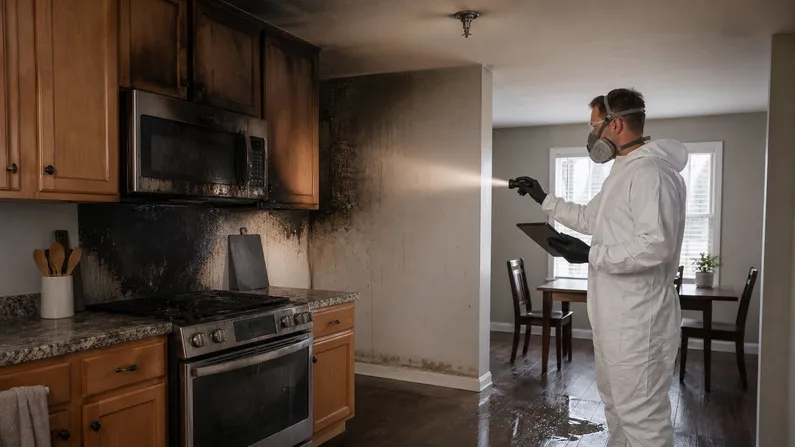
A useful assessment separates the loss into zones instead of treating the whole building as one uniform condition. The restoration team records the fire’s area of origin, visible heat effects, soot patterns, odor pathways, wet materials, suspected hidden moisture, and unaffected areas that need protection.
The assessment may include photographs, room notes, moisture readings, surface observations under focused light, material identification, and discussions with the owner or facility representative. It should also record items that cannot yet be evaluated because access is unsafe or a wall, ceiling, or floor assembly remains closed.
This documentation supports more than the insurance file. It becomes the working map for sequencing crews, equipment, contents handling, selective demolition, and reconstruction. A scope that says only “fire cleanup” can miss hidden wet materials. A scope that says only “water extraction” can overlook how uncontrolled airflow or foot traffic might move soot into cleaner spaces.
What is the correct restoration sequence?
No single sequence fits every property, but a qualified team should be able to explain why each step occurs when it does. The following order is common for a combined fire-and-water loss.
1. Secure the structure and control immediate hazards
Emergency board-up, roof protection, utility coordination, temporary barriers, and access controls may be needed before interior work begins. The team should identify unstable materials, electrical concerns, sharp debris, and areas that remain under fire-investigation control.
Stabilization is not the same as rebuilding. Its purpose is to prevent weather, unauthorized entry, or building movement from adding damage while the full scope is developed.
2. Document fire, smoke, soot, and water as separate conditions
Fire residues vary according to what burned, how hot the fire became, and how smoke moved. Water impact varies according to volume, duration, material porosity, and the route it traveled. Both need their own observations even when they occupy the same room.
The ANSI/IICRC S700 Standard for Professional Fire and Smoke Damage Restoration provides the professional framework for evaluating fire and smoke conditions, developing a restoration work plan, and documenting affected materials. Water mitigation also requires a defined drying plan and measured progress, not a visual guess that surfaces are dry.
3. Remove standing water and address wet materials
Once the area is safe for work, standing water should be removed and wet materials evaluated. Water can continue moving through porous finishes and concealed assemblies after the fire is out, so the visible edge of a wet area may not show its full extent.
Some materials can be dried and retained. Others may be unsalvageable because they are burned, delaminated, swollen, contaminated, structurally weakened, or impossible to clean. Decisions should be based on material condition and the project scope rather than a blanket rule that everything wet must stay or everything wet must be removed.
The EPA’s guide to mold, moisture, and the home recommends drying water-damaged areas and items within 24 to 48 hours when possible to reduce the chance of mold growth. That time frame is a reason to act promptly, not a guarantee that every material will be safe to retain after two days.
4. Coordinate drying with soot and residue control
This is one of the most important differences between a simple water loss and a combined fire-and-water loss. High-velocity airflow can move loose soot if residue control has not been considered. Conversely, delaying all drying while waiting for a complete smoke-cleaning phase can allow moisture damage to worsen.
The work plan may call for isolation of affected zones, removal of loose particulate, controlled air filtration, targeted water extraction, and carefully placed drying equipment. The exact sequence depends on residue type, wet materials, HVAC conditions, occupancy, and safety requirements. A restoration provider should be able to explain how it will dry the building without distributing fire residues into less affected areas.
5. Clean smoke and soot according to the surface
Soot is not one universal substance. Residue from a protein fire behaves differently from residue created by plastics, wood, oil, or a low-oxygen fire. A cleaning method that works on sealed metal may permanently mark unfinished wood, drywall, fabric, or stone.
Professional cleaning begins with residue identification, surface testing, and removal methods appropriate to the material. Dry particulate removal may precede wet cleaning on some surfaces. Items with deep heat damage, heavy contamination, or compromised structure may need to be removed instead of cleaned. Our guide to the difference between soot and smoke damage explains why surface appearance alone does not determine the treatment.
6. Evaluate contents before moving or discarding them
Furniture, electronics, documents, clothing, equipment, and sentimental items can have different combinations of heat, residue, odor, and water exposure. The contents plan should identify what can be cleaned on site, what may need pack-out, what requires a specialist, and what is not reasonably restorable.
Inventory records should connect each item or group of items to its original location and condition. Owners should ask how photographs, labels, storage, and disposition decisions will be documented before contents leave the property.
7. Verify conditions before reconstruction
Reconstruction should not cover damp cavities, active odor sources, loose residue, or unresolved damage. Before walls and finishes are closed, the team should confirm that the required drying, removal, cleaning, and odor work has reached the project criteria.
The rebuild may include framing, insulation, drywall, flooring, cabinets, paint, trim, and coordination with electrical, plumbing, or mechanical trades. For a broader look at the repair phase, see our guide to construction restoration after property damage.
What should property owners avoid after a fire?
It is understandable to want to begin cleaning immediately, but several common actions can complicate the loss:
- Do not re-enter an area that has not been released by the appropriate authority.
- Do not energize wet electrical equipment or appliances.
- Do not wipe soot with a wet household cloth before the residue and surface are evaluated.
- Do not run the building’s HVAC system if it may distribute smoke residues or draw contamination into clean areas.
- Do not move damaged contents without first documenting their location and condition when it is safe to do so.
- Do not let repairs cover materials that have not been evaluated for moisture, residue, and structural condition.
Emergency stabilization can begin quickly, but permanent decisions should follow a documented assessment. If a contractor recommends immediate broad demolition without explaining what is unsafe, unsalvageable, or needed for access, ask for the reasoning in writing.
How do insurance documentation and estimates work?
Fire-and-water claims can become confusing because one event produces several categories of work. Emergency services, water mitigation, fire cleaning, contents handling, demolition, odor treatment, and reconstruction may be documented in separate parts of the estimate even though they belong to one loss.
A clear project file may include:
- Initial photographs and room-by-room condition notes
- Emergency board-up or stabilization records
- Moisture maps, readings, and drying logs where applicable
- Contents inventories and pack-out records
- Cleaning tests and material disposition notes
- Demolition and repair scopes
- Change documentation when hidden damage is discovered
Coverage decisions belong to the insurance carrier and depend on the policy, cause of loss, exclusions, limits, and endorsements. The restoration company’s role is to document observed conditions, explain the proposed work, and communicate scope changes. Property owners should keep policy communications, receipts, temporary-living or business-interruption records, and copies of the restoration documentation.
What determines the timeline and cost?
A combined loss can take longer than a water-only or smoke-only project because several work streams must be coordinated. The timeline depends on structural safety, the fire’s size, the volume and travel path of suppression water, the number of affected rooms, drying conditions, contents, specialty materials, inspections, claim decisions, and the reconstruction scope.
Cost is shaped by many of the same factors. A small contained fire with limited sprinkler discharge is different from a multi-room fire with hose-water migration through several floors. It is also different from a commercial loss that requires shift work, tenant coordination, equipment protection, or phased reopening. Michigan business owners can review our commercial restoration planning guide for those operational considerations.
Be cautious with a firm completion date or total price offered before the property is accessible and assessed. A responsible provider can explain known work, likely contingencies, and the milestones that will make the scope more certain.
How should you choose a fire and water restoration company?
Look for one accountable team that can connect emergency response, water mitigation, fire and smoke cleaning, contents decisions, documentation, and reconstruction. Fragmented handoffs can leave gaps between what one contractor removed and what another contractor expects to rebuild.
Ask prospective providers:
- Who develops the combined work plan and coordinates the sequence?
- How will hidden moisture and smoke pathways be evaluated?
- What training and relevant certifications do the technicians hold?
- How will soot be controlled while wet materials are dried?
- Who documents contents, daily progress, and newly discovered damage?
- Can the company manage repairs after mitigation and cleaning are complete?
- How will the team communicate with the owner, adjuster, and other stakeholders?
Miracle Property Restoration has served Southeast Michigan since 1996 and provides 24/7 emergency response, IICRC-certified restoration services, contents support, and reconstruction coordination. If your home or business has both fire and suppression-water damage, call (855) 324-2921 or contact our team for an assessment and a recovery plan built around the actual conditions.
Frequently Asked Questions
What does this fire and water damage restoration guide explain?
Learn why a fire loss can also become a water loss, how combined fire and water damage restoration is sequenced, and what Michigan owners should expect.
When should a property owner contact a restoration professional?
Contact a qualified restoration professional when damage is active, hidden moisture may remain, regulated materials could be present, or the loss affects structural materials, indoor air quality, electrical systems, or normal building operations. Prompt assessment helps define safe next steps and limits avoidable secondary damage.
How does Miracle Property Restoration support a damage recovery project?
Miracle Property Restoration provides emergency stabilization, documentation, mitigation, remediation, and reconstruction for commercial and residential properties across Southeast Michigan. The team develops a property-specific scope, records conditions and progress, coordinates with project stakeholders, and restores affected areas after the immediate hazard is controlled.


